mandag 25. november 2013

NrK P2 Ekko - Do the social medias make us more social?

After the exciting experience of having NrK P2 Ekko visiting us at school, our class was invited to join them for their weekly live broadcast from Kulturhuset at Youngstorget. Some of us were once again sharing our broad knowledge and familiarity with the social medias, as the topic for this Tuesday´s broadcast was whether social medias make us more social or not!

The host of the show sat on a stage in front of us joined by “experts”, as far as one can be an expert on such a phenomenon, and quite a few interesting sides of the social medias were made clear to me. This is by no means an unknown topic to me, so I had a good idea of what would be discussed, but I was pleasantly surprised by the experts and their points of view. An important aspect that was brought up , in my opinion, was that the debate and attention around the use of social medias, is heavily influenced by the younger crowd. What is left out at many occasions is that the amount of users on the social medias exceed the youngsters by far, and that the older part of the users should not be left out.

Not to get off topic, do social medias make us more social? I myself actively utilize a variety of social medias during a day, and I would like to think they make me more social. However, defining “social” is crucial to this. If being social simply means I communicate or interact with other people, then sure, I´m social. Do social medias provide me with social experiences in any other way than me chatting with friends though? Do I meet new people online that I proceed to develop a real-life friendship with? I´m not so sure about that, and in a lot of scenarios, the social medias may prevent physical interactions with others, in the sense that I could rather just tell them what I´d like to say over Facebook.


At Ekko, they concluded to a certain degree that social medias make you more social, and I agree to that. It was a new and fun experience and I´d like to do it again, but I regret not volunteering to speak on behalf of my class. Nevertheless, I will bring what I learned from this along the way, as I´m positive this is not a topic that will fall off the hype-train anytime soon!

onsdag 13. november 2013

Eastwood & Tan illustrate cultural differences

Immigrants in Norway are becoming an increasing part of our population, whether they are first generation or second generation. However we are nowhere near being as multicultural as the nation across the Atlantic, the United States of America. The movie Gran Torino and the short story When Rich came to Sunday dinner both display the differences in culture between stereotypical Americans and immigrated minorities in USA. What can we learn from the two, and how do they compare?

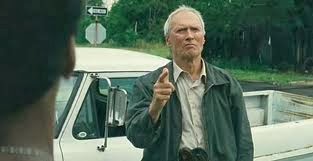
Walt teaching Thao what all the tools in his garage is for.
Gran Torino revolves around the ignorance, prejudice and difference between an American veteran of war, Walt, and his Hmong neighbors. The next-door-kid, Thao, is bullied by his cousin´s gang for not wanting to take part in their crimes and habits, and they convince him to attempt stealing Walt´s trophy car, the Gran Torino. Thao is caught by Walt when trying to steal the Gran Torino, and is forced by his family to offer Walt his services in order to make up for what he did. This is a Hmong tradition, and it is considered a great offence if Walt were not to accept. As a result, Walt and Thao become good friends, something Walt has very few of, and they both learn a lot from each other. For more detailed information see my previous post about Gran Torino.


“When Rich came to Sunday dinner” is an excerpt from the novel “The Joy Luck Club”, by Amy Tan. I have seen the film trailer for this book, and the expressed plot was how four Chinese mothers struggle to show their daughters how much they love them. Rich is the soon-to-be husband of the one daughter, though this is not familiar to her mother, and when he is first presented to the parents, two cultures collide like trucks. Especially food related traditions that aren´t very common in the Western hemisphere, makes for an awkward situation when Rich enjoys they Chinese food at dinner.

What these two have in common is that both the Hmongs and and Chinese have roots in Asia, some in China for the Hmongs as well. Traditions for cooking seem characteristic for them both, and family is important. This was educative for me, as I know very little about Asia in general, and here, a variety of scenarios illustrate their cultures. I figure I would reply much like Rich when the mother claims her food is awful, expecting everyone to disagree.
In both Amy Tan´s short story and Clint Eastwood´s movie, Asian people and cultures are in a close encounter with the Western-American culture. At one point they differ however, in Gran Torino there are clear signs of prejudice and ignorance from both the Hmongs and Walt, and while Rich seems quite ignorant to the Chinese traditions of his fiancée´s family, he doesn´t seem negative towards them. Gran Torino illustrates the two cultures in a bigger degree as it is a movie of course, but I think the fact that Walt´s knowledges of the Hmongs were as few as mine, makes it all a lot more educative. Gran Torino also shows the alleged pattern of how Hmong women go to college, whilst the men go to jail.


I think the Hmongs´ situation in USA is an important subject that deliberately has been focused in Gran Torino, and Clint Eastwood intends to put this on the agenda so to speak. It is hard to make something along these lines out of the excerpt from “The Joy Luck Club”, but it definitely goes to show how different people are in the melting pot of a nation the United States is.

tirsdag 5. november 2013

Gran Torino, strong dynamics

Walt Kowalski has just lost his wife, he has two sons that struggle to get along and communicate with him, and his neighborhood has become dominated by Hmongs. Walt is a veteran of war, and will never forget the terrible things he has done during the Vietnam War. Needless to say he is not happy, but refuses to make a change in his living.

I would describe Walt´s relationship with his sons as shallow. The level of communication and mutual understanding between Walt and his closest is poor. There is, however, a gradual improvement throughout the movie, particularly when Walt has just been to the doctor and tests positive for something I assume was fatal. My grandfather is 89 years old, and there is no doubt he was born many decades before me. He does not struggle to communicate with our family like Walt does with his, but I can see myself as one of the youngster in some of the scenarios from Gran Torino.

We never get to see the wife of Walt, but he describes her as the best thing that ever happened to him. The local priest insists that Walt must relief his sins in confession, but Walt refuses. Much like his relationship to his family, his relationship to his priest improves. The priest and Walt learn from each other, and both seem to benefit from their relationship in the end. I think there is clear resemblance between Walt´s attitude towards the priest and the Hmongs, his ignorance prevents him of seeing how they really are. Walt believes the priest is an overeducated youngster with no real experience with life and death. I think the turning point for their relationship is when they discover they have something in common; Thao and his family. It is at this point Walt corrects the priest when calling Walt “Mr. Kowalski”, and encourages him to address him by his first name. In Norway we have less of a tradition of using titles, and it has never been something I have considered utilizing. Nevertheless I have experienced the same growth of a relationship that Walt and the priest did.


When Walt called his son after having been to the doctor, something was different. I think Walt reckoned how nice it was to just have a casual conversation with his son, without there being a higher agenda to it all, like when his son called seemingly for the bare reason of getting his hands on tickets for a football game. At the point when Walt had been to the doctor, I think he had decided to make the Hmong gang shoot him in front of witnesses already, so he did not really care much for his sickness, as it would not affect him for much longer. In other words, he probably knew this would be his last conversation with his son, and did not want it to be a sad one. Walt´s situation is not unfamiliar to me, I lost my dad a couple of years back, and there are definitely some situations where I prefer keeping that to myself.

tirsdag 15. oktober 2013

Invictus


The Clint Eastwood-directed movie Invictus, starring familiar faces like Morgan Freeman and Matt Damon, revolves around the build-up to and thrills of the 1995 Rugby World Cup, hosted by South Africa. Through a great film we can learn a great deal about both the situation of South Africa in the early years post its “redemption” from the Apartheid, as well as important topics such as unity, equality and forgiveness. Morgan Freeman plays the main role as Nelson Mandela, and with charisma makes it impossible not to admire the man he in this scenario portrays with a striking resemblance.
Nelson Mandela (Morgan Freeman) states about the white people of South Africa in the film; “They are our fellow South Africans, our partners in democracy. And they treasure Springbok rugby. If we take that away, we lose them. We prove that we are what they feared we would be. We have to be better than that. We have to surprise them with compassion, with restraint, and generosity. I know. All of the things they denied us." Further on in movie he adds that the mutual racism between the white and black people of South Africa is an evil cycle that he by any means will put an end to.

The peak of excitement in Invictus is at the very end, where South Africa arises to beat their seemingly unbeatable opponent, the New Zealand All Blacks, in the Rugby World Cup final. A unique illustration of unity follows as the people of South Africa cheer and celebrate together, ignoring each other’s ethnicity and background. I believe this ending is to emphasize the words of Nelson Mandela (Morgan Freeman); unless we don´t prove to be better than what those who oppressed us feared us to be, we will never become united. I think this movie states a clear message that I completely agree with, and there is a reason Nelson Mandela will be in the history books for centuries. 

tirsdag 24. september 2013

Why would I study or work abroad?

It has become a common thing to study abroad, regardless of financial situation, nationality and culture. My mom worked in Canada for a year, my sister has studied for three years in Copenhagen and some of my closest friends are intending to go to college in America. Needless to say, studying or working abroad sounds fun! However, I realize that have a slim basis to conclude whether or not this is something for me, so I´ve talked to a part-time teacher at my school for more information on the topic.

Annicken, the daughter of my English teacher, states that her year abroad in France studying political science and courses about the EU, was a great year. She also had an internship in San Francisco as part of her master’s degree, and the experiences were good. Whether or not you have a good experience or not whilst studying or working abroad will depend on where you are and what you are doing, but some things are mutual. You will most likely improve in another language, whether that would be English or any other language for that matter, you will gain lingual skills that are well worth the trouble in our international society.


Annicken does point out that studying some places can be expensive, so it might not be possible for just about anyone. Nevertheless, this is not such a decisive factor in Norway, since education is free. I would encourage foreign(non-Norwegian) students to come to Norway to study. It might be expensive to live here while studying, but jobs are a lot better paid here as well, so hopefully it wont be a problem.

tirsdag 17. september 2013

The Raft, Peter Orner

The short story «The Raft» is narrated by the 13-year-old boy that is told the story of his grandfather. The grandfather is described as thoroughly as the grandson, but we see things through the eyes of the grandson. The son is retelling the story of his grandfather, by describing him telling it to himself in present, even though he is talking about something that happened in the past. The fact that the story is in present time, gives the reader a better impression of how it actually felt like being told that your grandfather killed a bunch of helpless Japanese.
"Don't smile," he says. "Just because I'm smiling, don't assume I couldn't kill you right now. Know that about a man." This is really the only thing I find ironic in the story. Of course his grandpa wouldn’t kill him, and the grandpa knows too.
In my opinion there is a distinct climax in the story when the grandfather admits he blew up the boat with naked Japanese. We now from the start of the story that he is telling a story from WWII, and we expect something violent and drastic, and our questions are answered by this revelation.

The topic is quite obviously war. Another interpretation could be that the author think we live in “peace” today, but we are ignorant to the fact that our ancestors fought a horrific war to get us here. 

www.thinkb4u.com

The name is quite descriptive of its content, think before you act. There are numerous examples, illustrated through short videos, shown on the site, and even though I barely browsed through about 10 per cent of these, I got an idea of what the purpose is. I don’t think this site is directed towards a specific age group, but there are a lot of people exposed to the dilemmas on www.thinkb4u.com. As a youngster and daily participant of the global internet, I should take this into a count the next time I face a decision like the ones on the site.
From an esthetic point of view the site is a masterpiece. Not only is it easily maneuverable, but the transitions and graphics are all very smooth. There is a lot of work behind this, but it makes the site so much more attractive and comfortable.
Thinking before you act should apply to every choice you makes during a day, but as an avid user of sites and services on the internet that demand personal information, I’d like to focus on this particular part of the topic. Every time you ignore and agree to “Terms of use” you expose yourself. Apple, Google and Facebook have been criticized for their alleged abuse of this, making their users agree to have their activity on the services registered. The group of people that are most vulnerable, to arguably this is youth.

Down below is an earlier post regarding the same topic:
http://kamelose.blogspot.no/2013/02/i-agree-to-these-terms.html